
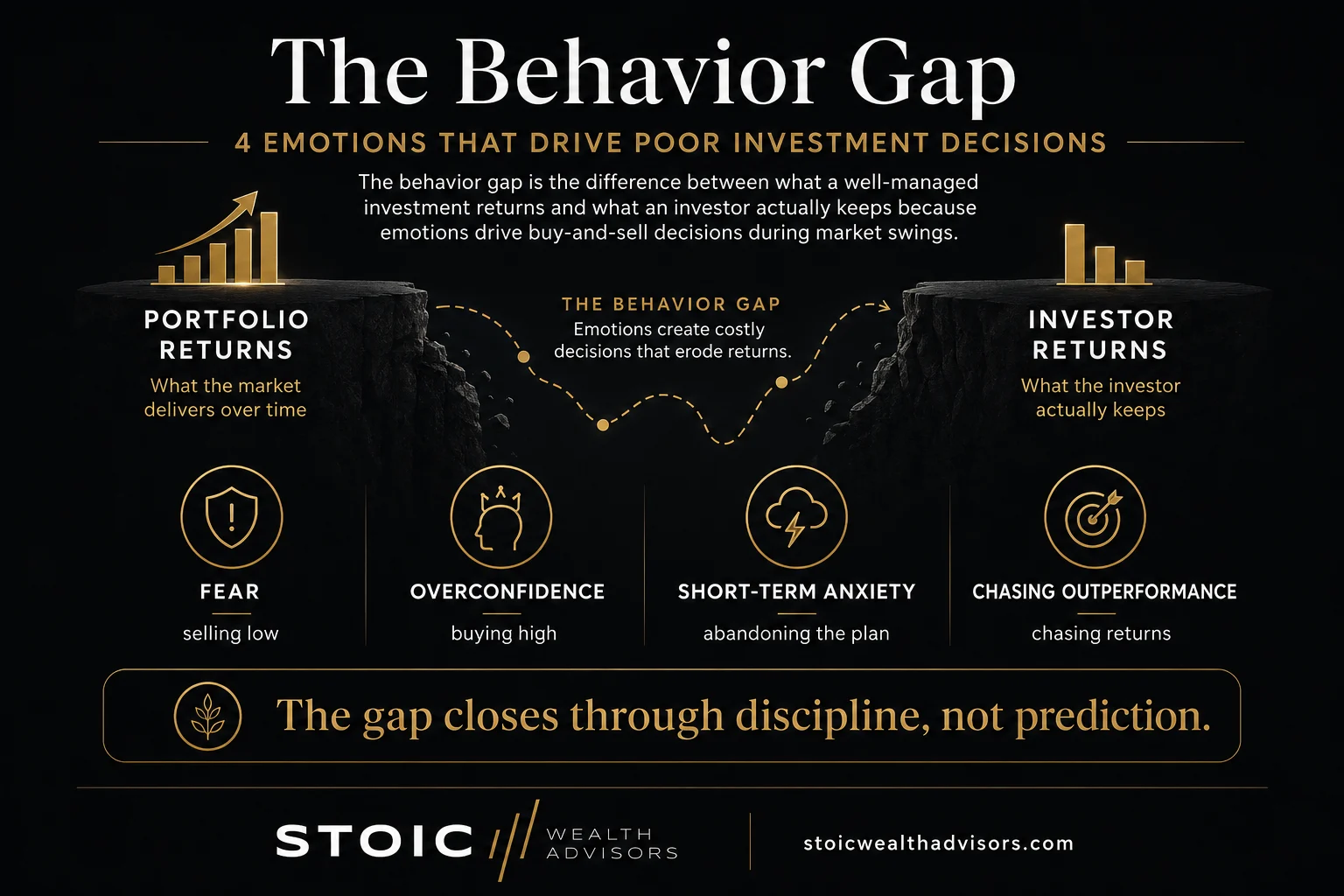
The behavior gap is the difference between what a well-managed investment returns and what an investor actually keeps, because of emotionally driven buy-and-sell decisions during market swings.
Carl Richards coined the term to describe the predictable pattern of investors underperforming.
their own portfolios. The four emotions most responsible: fear (selling low), overconfidence
(buying high), short-term anxiety (abandoning a long-term plan), and the search for outperformance
(chasing returns at the wrong moment). The gap closes through discipline, not prediction.
You can do everything right as an investor and still hurt your own returns. Consistent contributions, reasonable allocation, and a sensible plan. Then the market drops sharply, the headlines get loud, and everything you planned to do starts to feel like the wrong move.
That tension is not a flaw in the market. It is a feature of being human. And it has a name.
Carl Richards, author of The Behavior Gap, spent years drawing simple sketches to explain the gap between smart financial decisions and what people actually do. His insight was plain and a little uncomfortable: the biggest obstacle to good investment outcomes is usually not the market. It is the investor.
This article explains the four emotions most responsible for that gap, why each one is harder to catch than it looks, and the framework we use at Stoic Wealth Advisors when a client calls in the middle of a correction, ready to act.
What Is the Behavior Gap?
The behavior gap is the measurable difference between the return an investment produces and the lower return an investor actually captures, caused by buying and selling at emotionally driven moments rather than holding through complete market cycles.
Richards described his own experience this way: his job was not to find great investments. It was to help people become steady investors. The research consistently showed that investors underperformed the funds they held, not because the funds were poor, but because investors moved in and out of them at the wrong times.
Studies comparing investor returns to fund returns have documented this gap across different market environments and time periods. The pattern holds across investment types and income levels. It is not a problem unique to inexperienced investors. Physicians, attorneys, business owners, and financial professionals fall into the same patterns under the same emotional conditions.
Understanding the gap does not eliminate the emotions that create it. It gives you a framework for recognizing them before they drive a decision.
Dr. Chen and the 2022 Correction
Dr. Chen had been a client for several years before the fourth quarter of 2022. She had contributed consistently to her 403(b) throughout her career, built a diversified portfolio appropriate for her timeline, and maintained a written financial plan. She did not check her balance obsessively during normal periods.
Then her portfolio fell more than 20% over a few months. She started checking the balance daily. By December, she had made a decision: move everything to cash and wait until things stabilized.
She called our office before she acted.
The conversation was not about what the market would do. We do not know that, and neither does anyone else. What we talked through was simpler: had her plan changed, or had only the market changed? Her income was the same. Her timeline was the same. Her retirement was still over a decade away. Nothing that mattered to the plan had changed.
She stayed invested. She now uses that experience as her own reference point for the next time pressure builds. Not because the outcome proved her right in some triumphant way, but because she went through the process of deciding rather than reacting. That is the difference the behavior gap framework is designed to create.
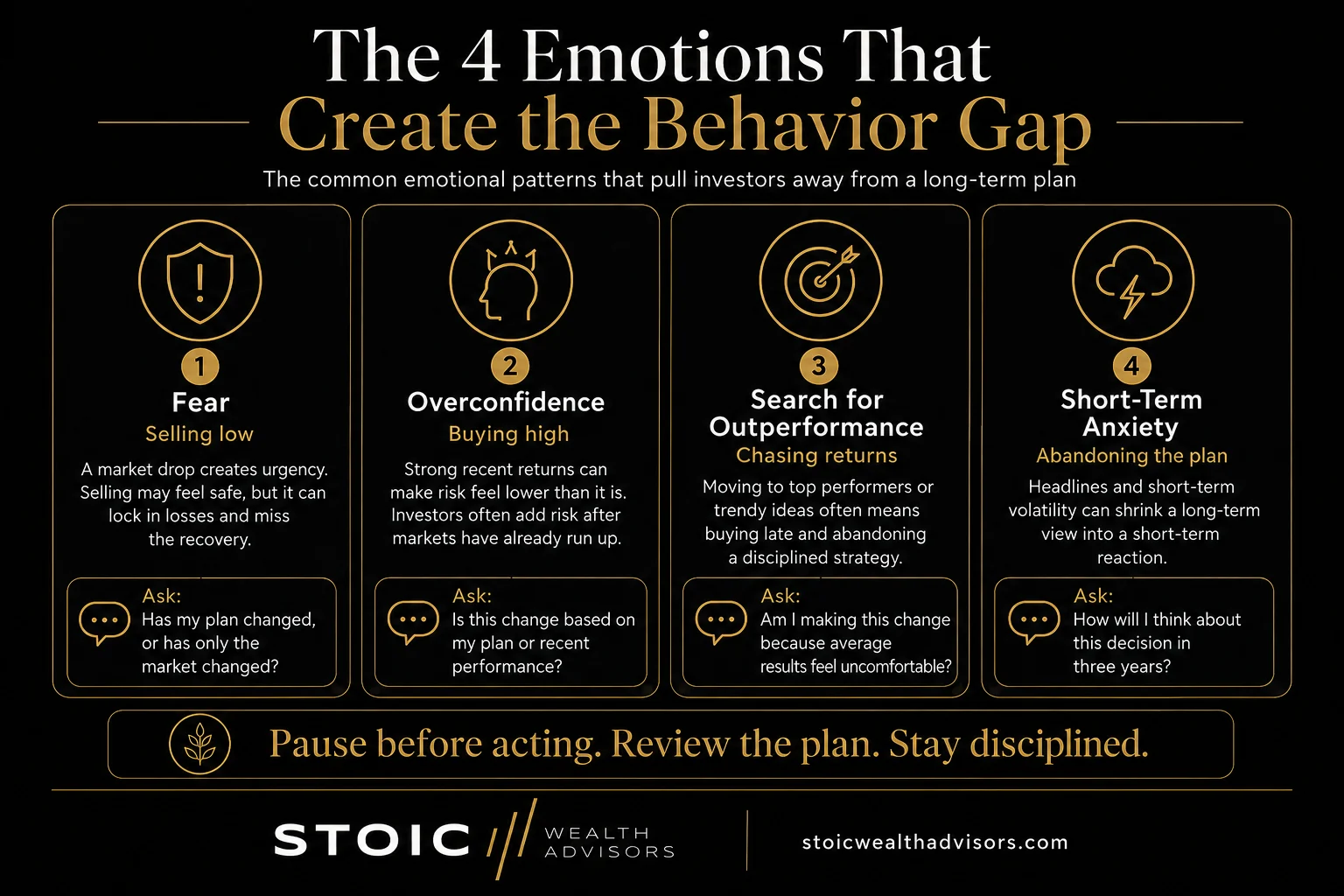
Emotion 1: Fear When Markets Fall
Fear is the most common and most expensive driver of the behavior gap. It produces one specific action pattern: selling at a loss after a decline, then waiting to reinvest until the market “feels safe,” which typically means waiting until prices have already recovered.
The emotional logic is coherent. A portfolio that has been growing for years is suddenly worth significantly less. Moving to cash feels like preservation. It feels like stopping further damage.
What it actually does is convert a paper loss into a permanent one. Selling during a decline locks in the lower price. The investor is then out of the market during the recovery. When the market feels safe enough to re-enter, prices have often already moved well above the exit point. The investor has now captured two declines and missed two recoveries.
Markets have recovered from every major decline in modern financial history. The timing and shape of recoveries vary, and past performance does not guarantee future results. But the practical risk for most long-term investors is not the market falling. It is selling when it does.
What to ask before acting: Has my plan changed, or has only the market changed? If income, timeline, expenses, and goals are unchanged, the plan is unchanged. The correct response to an unchanged plan in a changed market is usually to do nothing.
Emotion 2: Excitement and Overconfidence When Prices Are High
Overconfidence is fear’s counterpart. Where fear produces selling at the wrong time, overconfidence produces buying at the wrong time, and the two often work together across the same market cycle.
Extended periods of rising markets produce a feeling that is easy to mistake for knowledge. An investor who has watched a portfolio grow for three or four years may begin to believe that risk is simply lower than it was before. They increase equity exposure. They reduce diversification. They stop reviewing their allocation because everything seems to be working.
This also shows up as conviction in specific sectors or themes. An investor becomes confident in a particular asset class, allocates a meaningful portion of the portfolio to it, and is then disproportionately exposed when that thesis reverses.
In both cases, recent performance has replaced the discipline of the plan. The portfolio now reflects a mood rather than a strategy.
What to ask before acting: Is this change to my portfolio based on my plan, or based on how the market has made me feel recently? If the allocation is drifting upward because performance has been strong, it may be time to rebalance back to target weights, not because a decline is coming, but because the risk level is now higher than planned.
Emotion 3: The Search for Above-Average Returns
The pursuit of alpha, the financial term for returns above the market benchmark, is one of the most persistent sources of underperformance for individual investors. The emotional desire to outperform leads investors into behaviors that produce the opposite result.
This shows up in several ways. Frequent portfolio changes based on news or market commentary. Moving from fund to fund based on recent top-performer lists. Adding complexity to a plan that was working because a simpler plan feels like leaving something on the table.
The irony Richards identified is that investors who pursue alpha most aggressively tend to capture less of their portfolio’s actual return. The transaction costs, tax implications, and timing errors compound. The fund outperforms the investor who holds it.
For healthcare professionals and other high earners who apply the same energy to their finances as they do to their professional performance, this pattern is particularly common. Discipline in one domain does not transfer automatically to the other.
What to ask before acting: Am I making this change because the plan calls for it, or because I am uncomfortable with average results? Consistent, market-rate returns compounded over a long timeline produce outcomes that most active strategies do not beat net of costs and taxes.
For more on this, Active vs. Passive Investing walks through the practical trade-offs for long-term investors.
Disclosure: Alpha measures the difference between a portfolio’s actual returns and its expected performance, given its level of risk as measured by Beta, which measures volatility relative to its benchmark. A positive (negative) Alpha indicates the portfolio has performed better (worse) than its Beta would predict. (113-LPL)
Emotion 4: Short-Term Anxiety and Losing the Long View
Short-term anxiety is the most universal of the four emotions because it is not tied to market direction. It shows up in bull markets and bear markets, in periods of economic growth and economic contraction. It is the tendency to let the immediate moment consume the longer-term picture.
Market disruptions, health crises, geopolitical events, and election cycles all amplify the feeling that today’s conditions are exceptional and therefore require an exceptional response. They rarely do.
Most of the time, they do not. A financial plan built around a twenty-year retirement horizon should not need to be restructured in response to a three-month market event. The plan already accounts for disruption. That is part of what a plan is for.
What short-term anxiety does is compress the time horizon. An investor who should be thinking in decades starts thinking in weeks. Decisions that would be obviously wrong from a long view feel obviously right from a short one.
What to ask before acting: How will I think about this decision in three years? If the honest answer is that it will look reactive and unnecessary, that is important information about what is actually driving the impulse.
If short-term anxiety is also connected to broader financial uncertainty, 5 Stoic Habits That May Help You Build Financial Discipline Over Time addresses the behavioral framework directly.
A Framework for Responding to Volatility Without Reacting
The four emotions above create the behavior gap because they are triggered by events outside your control and redirected toward decisions inside your control, usually in ways that undermine the plan. The following four questions slow that process enough to separate the emotion from the action.
Work through these in order before making any portfolio change during a period of market stress:
- Has my financial situation changed, or has only the market changed? If income, timeline, expenses, and goals are the same, the plan is the same.
- What would I think of this decision in three years? Most reactive investment decisions look clearly wrong from a short-term distance.
- Am I responding to the market, or to how the market is making me feel? These are different problems with different correct responses.
- Have I spoken with a financial advisor before acting? The value of that conversation is not that it will always change the decision. It introduces enough deliberate reflection for the emotion to be identified before the action is taken.
These questions are not a guarantee of good behavior. They are a speed bump between an emotion and a decision. In most cases, that is enough.
What You Can Control When Markets Move
One of the most practical reframes for market volatility is to separate what is within your control from what is not. The Stoic tradition made this distinction clearly, and it applies directly to investment behavior.
You cannot control: market direction, interest rate decisions, inflation, geopolitical events, or corporate earnings.
You can control:
- Whether you stay invested or sell during a decline
- Your asset allocation and whether it still reflects your actual timeline and risk tolerance
- Whether you continue contributing consistently, including during market downturns
- Whether you have a liquid emergency fund that removes the need to sell investments at the wrong time
- Whether you review your plan with an advisor before making changes, rather than after
The list of things you can control is shorter than most investors want. Acting on that shorter list consistently, over a long time period, produces the outcomes that the behavior gap prevents.
If you are working through a related decision alongside this, Should You Pay Off Debt or Start Investing? covers the framework for investors weighing competing financial priorities.
The Behavior Gap in Practice: Two Investor Timelines
The difference between an investor who closes the gap and one who does not is rarely intelligence or financial knowledge. It is usually the presence or absence of a decision-making framework at the moment when emotional pressure is highest.
| Investor Who Reacts | Investor Who Decides |
| Checks balance daily during a correction | Reviews balance at scheduled quarterly intervals |
| Moves to cash after a 20% decline | Stays invested; reviews whether plan has changed |
| Waits for confidence to return before reinvesting | Continues contributing consistently through the decline |
| Re-enters near the next market peak | Portfolio recovers alongside the market |
| Captures the decline and misses the recovery | Captures both sides of the cycle over time |
| Repeats the pattern in the next correction | Has a reference point for staying the course next time |
At Stoic Wealth Advisors, we use risk tolerance reviews as a starting point for every planning relationship, not a box to check at account opening. How you actually respond to market movement, not just how you say you will respond, determines how a portfolio should be built and how communication should be structured when conditions get uncomfortable.
Frequently Asked Questions: The Behavior Gap
1. What is the behavior gap in investing?
The behavior gap is the difference between the return an investment produces and the lower return an investor actually captures, caused by emotionally driven timing decisions. Carl Richards coined the term to describe the consistent pattern of investors underperforming the portfolios they hold because they buy after markets have risen and sell after they have fallen, missing the recoveries that typically follow declines.
2. Why do investors sell investments during market downturns?
Fear is the primary driver. When a portfolio balance falls sharply, and financial media coverage becomes alarming, selling feels like taking action to stop further damage. Psychologically, it resolves the discomfort of watching a declining number. Financially, it converts a temporary paper loss into a permanent realized one and removes the investor from the recovery that typically follows. The discomfort of staying invested is real. The cost of selling is usually higher.
3. How much does the behavior gap cost investors over time?
The cumulative cost is significant. An investor who captures even 10% less than their portfolio’s actual return each year due to poorly timed buy and sell decisions loses a substantial portion of the compounding benefit that makes long-term investing effective. The gap does not appear dramatic in any single year. Over twenty or thirty years, it substantially changes outcomes.
4. What is the best way to avoid emotional investment decisions?
Build a written plan with a defined asset allocation before a market decline occurs. Include in that plan a specific statement of the conditions under which you would make changes, and commit to making no changes outside of those conditions without first speaking with a financial advisor. Decisions made in advance of emotional pressure consistently produce better outcomes than decisions made during it.
5. Does having a financial advisor reduce the behavior gap?
Yes, when the relationship includes structured decision-making during market volatility, not just portfolio construction. The most valuable function an advisor serves during a correction is often not to provide a prediction but to provide a process: reviewing whether a proposed change is driven by a genuine plan adjustment or by an emotional response to price movement. That process, applied consistently, is what keeps the gap from opening.
Disclosures: Asset allocation does not ensure a profit or protect against a loss.
Rebalancing a portfolio may cause investors to incur tax liabilities and/or transaction costs and does not assure a profit or protect against a loss.
There is no guarantee that a diversified portfolio will enhance overall returns or outperform a non-diversified portfolio. Diversification does not protect against market risk.
Alpha measures the difference between a portfolio’s actual returns and its expected performance, given its level of risk as measured by Beta, which measures volatility relative to its benchmark. A positive (negative) Alpha indicates the portfolio has performed better (worse) than its Beta would predict.