

The strongest signs to look for when choosing a financial advisor include relevant experience with medical professionals, planning that extends beyond investments, clear explanations of fees and conflicts, and an ongoing service process that can adapt to career changes. Referrals can help you create a shortlist, but you should still verify the advisor’s credentials, registration, services, and compensation.
Choosing a financial advisor requires more than comparing investment performance or professional titles. Physicians, nurses, healthcare executives, and practice owners often face connected decisions involving student loans, workplace benefits, insurance, taxes, family priorities, and retirement.
A physician-friendly financial advisor should understand how these issues affect one another. The advisor should also explain the reasoning behind each recommendation so you can make an informed decision without unnecessary pressure.

Sign #1: They Have Referrals from Other Medical Professionals
Referrals from other healthcare professionals can help you identify advisors who already understand the financial realities of a medical career. However, a referral should begin your evaluation, not complete it.
What a Physician Referral Can Reveal
A colleague can often tell you what marketing materials cannot. They may be able to describe whether the advisor communicates clearly, responds promptly, follows through on action items, and understands healthcare-specific career transitions.
Ask colleagues about the service they receive, not only their investment returns. Useful questions include:
- What financial concerns does the advisor help you address?
- Does the advisor explain why each recommendation fits your situation?
- Does the advisor coordinate with your tax or legal professionals?
- Were the advisor’s services and costs clear from the beginning?
- How does the advisor respond when your career or family circumstances change?
A positive referral carries more value when the colleague has needs similar to yours. A retiring surgeon, a resident, an employed nurse practitioner, and a physician buying into a practice may require different planning services.
Why a Referral Is Only a Starting Point
Experience with physicians does not automatically prove that an advisor is qualified, transparent, or suitable for your needs.
Some advisors may work primarily with physicians approaching retirement. Others may focus on younger healthcare professionals who are managing student loans and workplace benefits. The right experience depends on your current career stage and the decisions ahead of you.
Ask the advisor how their planning approach changes between residency, early practice, peak earning years, practice ownership, and retirement. A detailed response should demonstrate more than familiarity with medical terminology.
Our discussion of why physicians may need an industry-aware advisor provides additional context for how medical career experience can affect financial planning.
Verify Credentials and Registration
Do not accept a professional title or credential at face value. Confirm what the designation requires, whether it includes continuing education, and whether the issuing organization allows the public to verify credential holders.
FINRA maintains a professional designations database that explains the requirements behind many credentials. FINRA also states that inclusion in its database does not represent an endorsement.
You should also check whether the advisor and firm are registered and whether they have disclosed disciplinary history. Investor.gov provides a financial professional search tool that directs users to the appropriate SEC or FINRA database.
Question to ask the advisor:
“What experience do you have with healthcare professionals at my career stage, and how does that experience affect your planning process?”

A strong financial advisor for healthcare professionals should view your financial life as a connected system.
Sign #2: They Can Serve as Your ‘One-Stop-Shop’
A one-stop shop should not mean that a single advisor claims to handle every financial, tax, insurance, and legal function. It should mean the advisor can examine your financial life as a connected system and coordinate with qualified professionals when necessary.
What Comprehensive Planning Should Cover
Healthcare professionals frequently manage several financial priorities at the same time.
A physician moving from residency into an attending position may want to accelerate student loan payments, increase retirement contributions, build cash reserves, purchase a home, and review insurance coverage. All these goals compete for the same income.
A comprehensive advisor should understand how decisions involving one area can affect the others. Depending on your circumstances, the planning conversation may include:
- Student loans and monthly cash flow
- Emergency reserves and investing
- A 401(k), 403(b), or other workplace plan
- Disability insurance and future earning capacity
- Life insurance and beneficiary designations
- Investment risk and liquidity
- Practice ownership or employment changes
- Retirement timing
- Family and estate-planning priorities
- Coordination with tax and legal professionals
The advisor does not need to provide every service personally. The advisor should recognize when your CPA, attorney, insurance professional, or another specialist needs to participate.
How Financial Decisions Affect One Another
Financial recommendations should not be made in isolation.
For example, paying student loans faster may reduce interest costs, but directing every available dollar toward debt could leave you without adequate emergency savings. Increasing retirement contributions may support long-term goals, but the decision should also account for near-term expenses, liquidity, and workplace-plan rules.
Insurance decisions also connect with the larger financial plan. Disability coverage may be especially relevant when your future income is one of your most valuable financial resources. Life insurance needs may change when you marry, have children, assume business obligations, or accumulate enough assets to support your family in other ways.
Our overview of critical financial strategies for physicians explains several financial areas that may need to work together.
Confirm What the Relationship Includes
Terms such as “wealth management” and “comprehensive planning” do not always describe the same services.
Ask the advisor to explain:
- Which planning services are included
- Which services are not included
- Whether investment management is required
- Whether separate services carry additional costs
- How often is the financial plan reviewed
- Who is responsible for implementing recommendations
- How the advisor coordinates with outside professionals
- Who will serve as your primary contact
Registered broker-dealers and registered investment advisers must provide retail investors with a relationship summary known as Form CRS. It describes the firm’s services, fees, conflicts, standards of conduct, and reportable disciplinary history. Investors can use FINRA’s BrokerCheck to review a brokerage professional’s or brokerage firm’s registration history, qualifications, employment history, and certain disclosures, including regulatory actions, customer disputes, and disciplinary events.
Review the advisor’s Form CRS and other applicable disclosure documents before making a decision. You can also compare the proposed scope with the services described on our What We Do page.
Watch for Product-First Advice
Be cautious when an advisor recommends an investment, insurance product, account transfer, or debt strategy before learning enough about your situation.
A responsible discovery process should address your goals, income, debt, cash reserves, workplace benefits, insurance, family responsibilities, and expected career changes. Recommendations made before that discussion may reflect assumptions rather than a complete analysis.
Question to ask the advisor:
“How would you prioritize my competing financial goals, and which parts of my financial life would your services cover?”
Stoic Wealth Advisors and LPL Financial do not offer tax or legal advice. Please consult qualified tax and legal advisors regarding your individual situation.

Fee transparency helps healthcare professionals compare advisors with greater confidence.
Sign #3: They Can Help Cut Through the Noise
A suitable advisor should make financial decisions easier to evaluate. The advisor should explain the reasoning, risks, costs, and alternatives rather than adding more terminology or sales pressure.
They Explain the Reasoning Behind Recommendations
Healthcare professionals may receive offers involving student loan repayment, refinancing, insurance, retirement plans, investments, practice financing, and real estate.
Each offer may be presented as urgent. A useful advisor should help you determine:
- Which decision needs attention now
- Which decision can wait
- What problem each recommendation addresses
- What assumptions support the recommendation
- What risks remain
- What alternatives were considered
- What could cause the recommendation to change
An advisor should not expect you to accept a recommendation simply because it sounds sophisticated. You should understand enough of the logic to evaluate whether the recommendation fits your goals.
They Put Investment Risk in Context
Risk tolerance is only one part of an investment discussion.
Risk tolerance refers to your emotional comfort with market movement. Risk capacity refers to your financial ability to withstand a loss or period of volatility without disrupting important goals.
A physician may be comfortable accepting substantial market risk but still have limited risk capacity if the money will soon be needed for a home purchase, practice investment, tax payment, or another short-term goal.
A thoughtful advisor should also consider:
- Your time horizon
- Your need for accessible cash
- The stability of your income
- Your concentration in one company or industry
- Your debt obligations
- Your family responsibilities
- The amount of time available before retirement
Investing involves risk, including possible loss of principal. An advisor should discuss that risk directly rather than suggesting that a strategy can eliminate uncertainty or prevent every loss.
Our article on financial health for medical professionals offers a broader look at how individual decisions fit into the overall financial picture.
They Clearly Explain Fees and Conflicts
No single compensation model proves that an advisor is honest, independent, or suitable. Different arrangements create different costs and incentives.
Ask the advisor to explain every way the advisor and firm may receive compensation through your relationship. You should understand:
- Whether charges are ongoing or one-time
- Whether fees are based on assets, time, transactions, products, or a flat amount
- Whether investments carry expenses beyond the advisor’s fee
- Whether different recommendations create different compensation
- Whether a third party may compensate the advisor or firm
- Whether additional planning services carry separate charges
- Whether costs change as your assets or service needs change
- What happens to fees if you end the relationship
Investor.gov advises investors to ask how an investment professional is paid and to translate percentage-based fees into dollar amounts.
A weak explanation may rely on phrases such as “the fee is standard” or “you do not pay us directly.” Those statements do not explain the total cost or the incentives involved.
They Welcome Questions and Independent Verification
A financial advisor should be comfortable with informed questions. Reasonable due diligence is not a sign that you distrust the advisor. It is part of selecting a professional who may influence important financial decisions.
Ask for written documentation when discussing:
- Services
- Fees
- Conflicts
- Credentials
- Registration
- Disciplinary history
- Investment expenses
- Account termination
- Ongoing communication
Investor.gov provides suggested conversation starters for financial professionals, including questions about qualifications, fees, conflicts, investment selection, disciplinary history, and the client’s primary contact.
Warning Signs During the First Conversation
Notice how the advisor responds when you ask for details.
Possible red flags include:
- Recommending a product before understanding your situation
- Focusing mainly on recent investment performance
- Making confident market predictions
- Avoiding direct questions about compensation
- Using professional titles without explaining what they mean
- Creating pressure to decide immediately
- Dismissing alternatives without explanation
- Suggesting that one product can solve several unrelated concerns
- Discouraging you from reviewing written disclosures
- Claiming to handle tax or legal matters without the appropriate professional involvement
Question to ask the advisor:
“What facts support this recommendation, what alternatives did you consider, and how would you or your firm be compensated?”
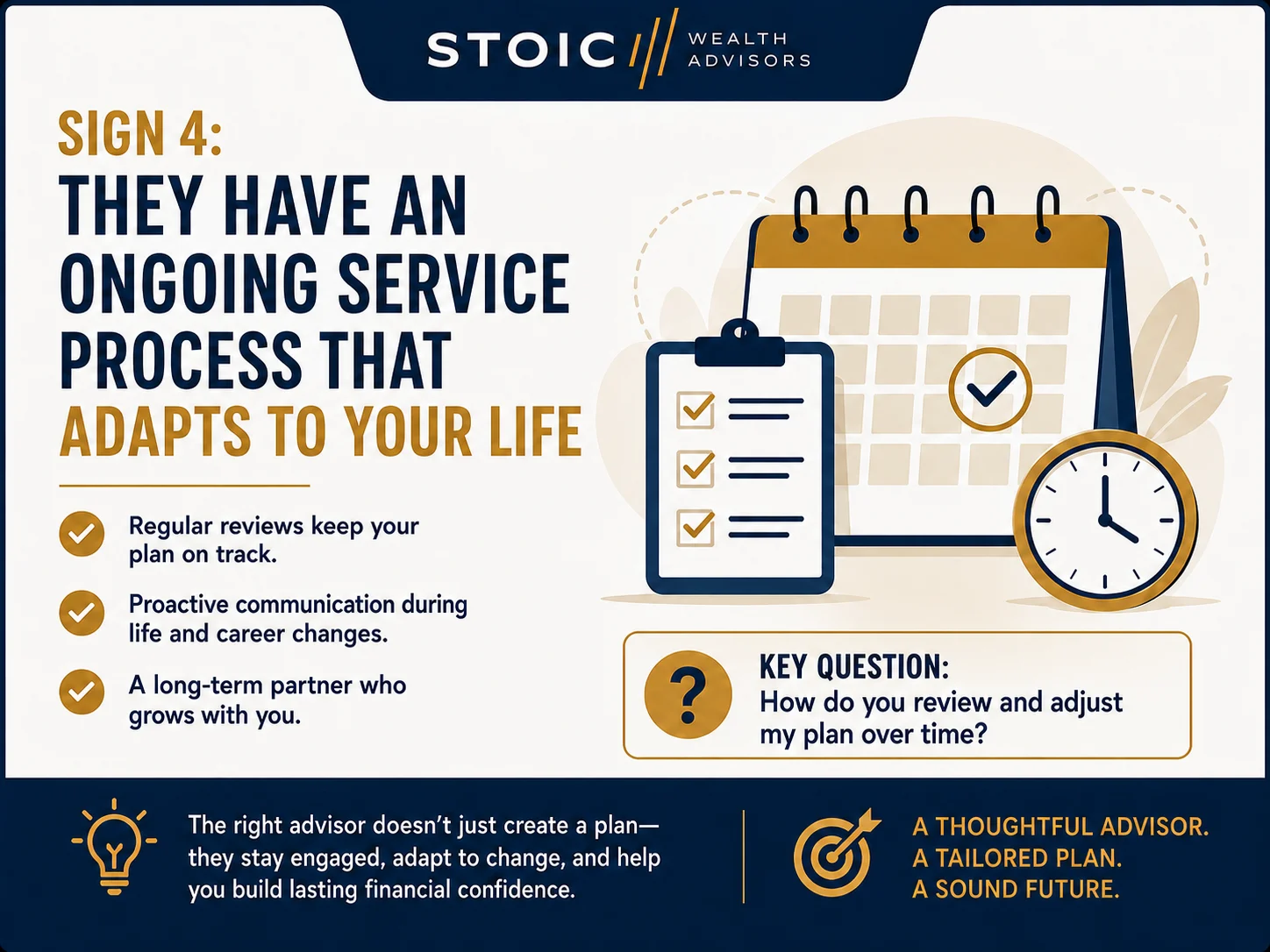
Sign #4: They Can Build a Long-Lasting Relationship
A long-term advisor relationship should evolve as your medical career, family responsibilities, and financial priorities change.
Their Process Adapts to Your Career Stage
Different career stages create different planning needs.
A resident may focus on cash flow, student loans, emergency savings, and basic insurance protection. A new attending may need to manage a rapid increase in income while balancing retirement contributions, debt reduction, taxes, and lifestyle changes.
An employed physician may need guidance related to workplace benefits, including a 401(k), 403(b), pension, deferred compensation arrangement, or insurance coverage. A practice owner may need to coordinate business decisions with personal savings, risk management, and retirement goals.
Later in a career, the focus may shift toward retirement timing, income needs, investment risk, estate priorities, and the transition away from earned income.
An advisor should recognize these changes rather than applying the same planning priorities throughout your career.
They Have a Defined Review Process
A long-lasting relationship requires more than an annual investment review.
Ask how the advisor reviews changes involving:
- Income
- Spending
- Student loans and other debt
- Workplace benefits
- Insurance coverage
- Investment risk
- Retirement projections
- Family responsibilities
- Beneficiary designations
- Estate documents
- Tax-planning opportunities that require CPA coordination
You should also know when to contact the advisor between scheduled reviews.
Events that may justify an additional conversation include:
- Completing training
- Signing a new employment agreement
- Changing employers
- Moving to another state
- Buying into or leaving a practice
- Starting or selling a business
- Marriage or divorce
- The birth or adoption of a child
- A substantial change in income
- A disability or major health event
- Receiving an inheritance
- Preparing to retire
A proactive advisor should explain which events may affect the plan and how updates can be handled.
They Have a Service Continuity Plan
A relationship that may last for decades should not depend entirely on one person.
Ask what happens if your primary advisor retires, changes firms, becomes unavailable, or can no longer serve you. Determine whether other team members understand your plan and whether the firm has a process for transferring responsibilities.
Also, ask who will:
- Answer routine questions
- Prepare for review meetings
- Monitor outstanding action items
- Coordinate with outside professionals
- Contact you when documents or decisions require attention
- Assume responsibility if your primary advisor is unavailable
You can review our firm’s background and planning approach before an introductory meeting.
Question to ask the advisor:
“How will your advice and service process adjust as my career, income, family, and retirement timeline change?”
Questions to Ask Before Choosing a Financial Advisor
Use the same questions during each introductory meeting. Consistent questions make it easier to compare advisors based on substance rather than personality or presentation style.
- Are you fiduciary?
- What experience do you have with healthcare professionals at my career stage?
- What information do you need before making a recommendation?
- How would you prioritize my debt, cash reserves, workplace benefits, insurance, and investing?
- Which planning services are included?
- Which services are excluded?
- How are you and your firm compensated?
- What conflicts of interest could affect your recommendations?
- How do you evaluate risk tolerance, risk capacity, time horizon, and liquidity?
- How do you select investments?
- When would you coordinate with my CPA, attorney, or another professional?
- How often will we review my financial plan?
- Which career or family changes should prompt an additional meeting?
- Who will be my primary contact?
- What happens if my primary advisor becomes unavailable?
- How can I verify your registration and credentials?
- Which written disclosures should I review before deciding?
Record the answers shortly after each meeting. Note which advisor asked thoughtful questions, explained trade-offs, disclosed limitations, and gave you enough information to evaluate the relationship.
How to Compare Your Options
Do not choose an advisor based on one appealing quality. A physician-friendly specialty, a professional credential, a strong referral, or a polished presentation does not establish overall suitability.
Compare each advisor across the same areas:
| Evaluation Area | What to Review |
| Healthcare experience | Experience with professionals at your career stage |
| Planning scope | Services included and excluded |
| Compensation | Total costs and sources of compensation |
| Conflicts | Incentives that may affect recommendations |
| Communication | Meeting schedule, response process, and primary contact |
| Coordination | Work with tax, legal, insurance, and other professionals |
| Investment approach | Goals, risk, costs, liquidity, and time horizon |
| Ongoing reviews | How the plan is monitored and updated |
| Continuity | What happens if the primary advisor becomes unavailable |
| Professional background | Registration, credentials, and disciplinary history |
The best fit depends on your needs, not another person’s experience. An advisor may be qualified and transparent but still offer the wrong service model, communication process, or planning scope for your situation.
Taking the Next Step With Greater Clarity
The clearest signs of a good financial advisor are not confident predictions or impressive sales materials. Look for relevant questions, connected planning, transparent explanations, independent verification, and a process that can adapt over time.
At Stoic Wealth Advisors, we aim to add clarity to an overly complicated financial world. We believe healthcare professionals should understand the reasoning behind a recommendation, the trade-offs involved, and the next decisions that deserve attention.
When you are ready to discuss your financial priorities, you can schedule a time to Meet With Luke. An introductory conversation can help determine whether our services, communication, and planning approach align with your needs.
This material is for general educational purposes only and is not individualized investment, tax, legal, or insurance advice. Investing involves risk, including possible loss of principal. Stoic Wealth Advisors and LPL Financial do not offer tax or legal advice. Please consult qualified tax and legal professionals regarding your individual situation.