

The five stoic financial habits that translate directly into financial discipline are: (1) focus only on what you can control, (2) prepare for what you cannot predict, (3) make decisions with long-term patience, (4) spend in alignment with what you actually value, and (5) hold yourself accountable through a consistent review process. Each Stoic philosophy principle has a concrete personal finance application that separates investors who stay on plan from those who react to short-term pressure.
Most people who struggle financially are not uninformed. They know they should save more, review their insurance, and look at their allocation. The knowledge is not the problem.
The problem is that knowing what to do and actually doing it are different challenges. A physician who understands compound interest can still move to cash during a correction. A nurse who knows she should increase her 403(b) contribution can still put it off for another quarter, then another year.
That gap between knowing and doing is where financial plans quietly lose ground. Building financial habits means practicing consistency with what you believe, even under pressure, which is what closes it. Stoic philosophy applied to personal finance is not a new idea. It is a discipline Marcus Aurelius described in private journals and Seneca outlined in letters, and its core principle, focus on what you can control and prepare for what you cannot, translates directly into financial decision-making.
We are called Stoic Wealth Advisors for a reason. These are not principles we cite in blog posts and set aside. They shape how we approach every planning conversation. Here are the five Stoic financial habits that matter most for long-term investing discipline, with the specific financial application for each.
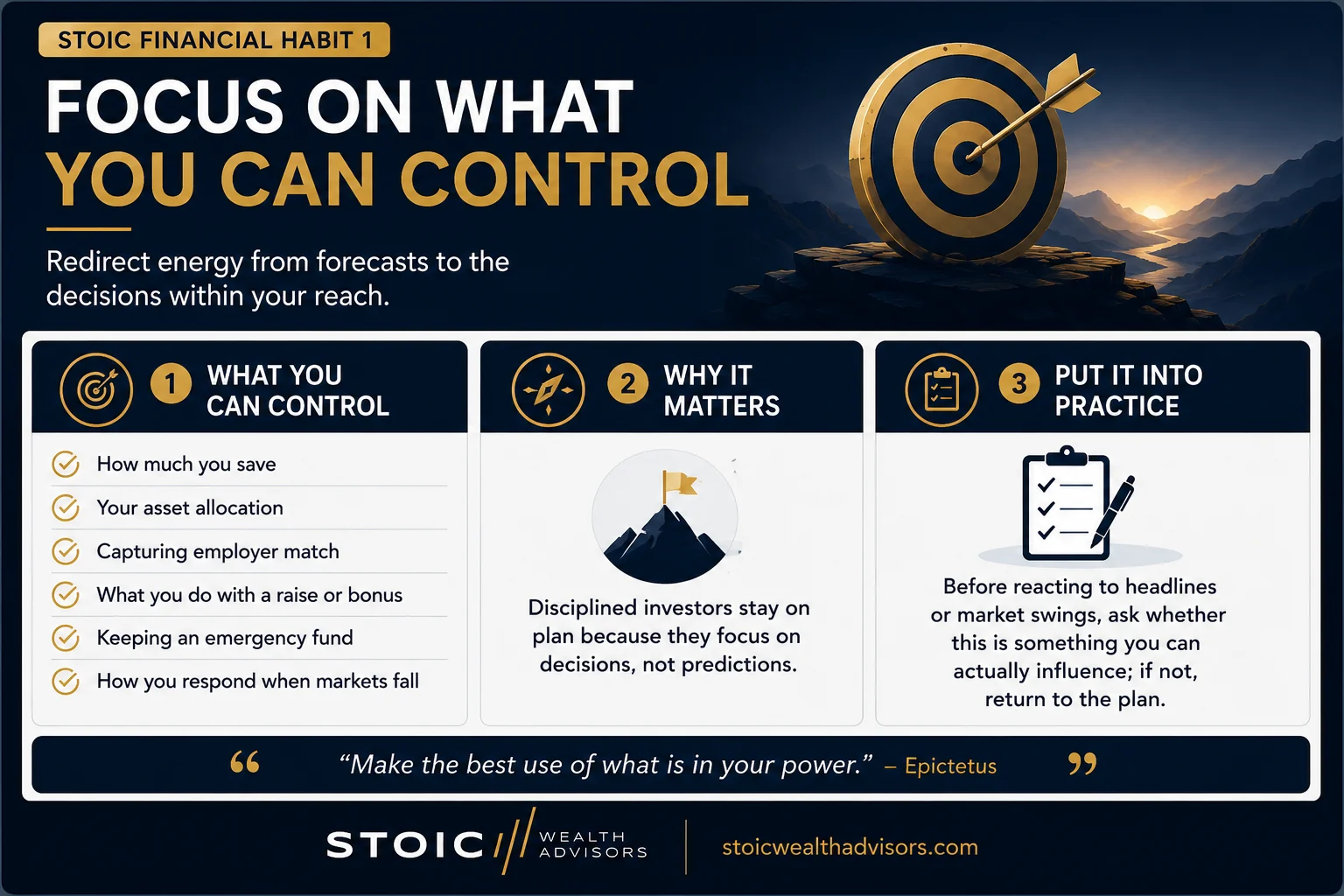
Stoic Financial Habit 1: Focus Only on What You Can Actually Control
The most financially damaging decisions most investors make are reactions to things they cannot control. This first stoic financial habit, separating what is within your reach from what is not, is the foundation every other financial discipline habit builds on. Market direction, interest rate decisions, inflation data, geopolitical events: none of these are within reach, yet they drive a significant portion of the portfolio changes people make.
“Make the best use of what is in your power, and take the rest as it happens.” – Epictetus, Enchiridion
Epictetus spent his early life as an enslaved person. His philosophy of control was not abstract. He understood, from the inside, what it meant to have almost nothing within reach and to have to decide what to do with that smaller list.
In financial planning, the list of what you can control is also shorter than most people want. But it is not empty:
- How much you save each month, and whether that amount adjusts as income grows
- How your portfolio is allocated between asset classes, and whether that allocation reflects your actual timeline
- Whether you capture an available employer match on a 401(k) or 403(b)
- What do you do with an income increase, a bonus, or a windfall
- Whether you have a liquid emergency fund before taking on investment risk
- How you respond when your balance falls
The investors who stay on plan through market cycles are not the ones who predict correctly. They are the ones who stop expending energy on the forecast and redirect it toward the plan.
Put it into practice: Before making any financial change in response to news, headlines, or market movement, write down what you are reacting to and ask whether it is something you can actually influence. If the answer is no, the plan does not change. Return to it.
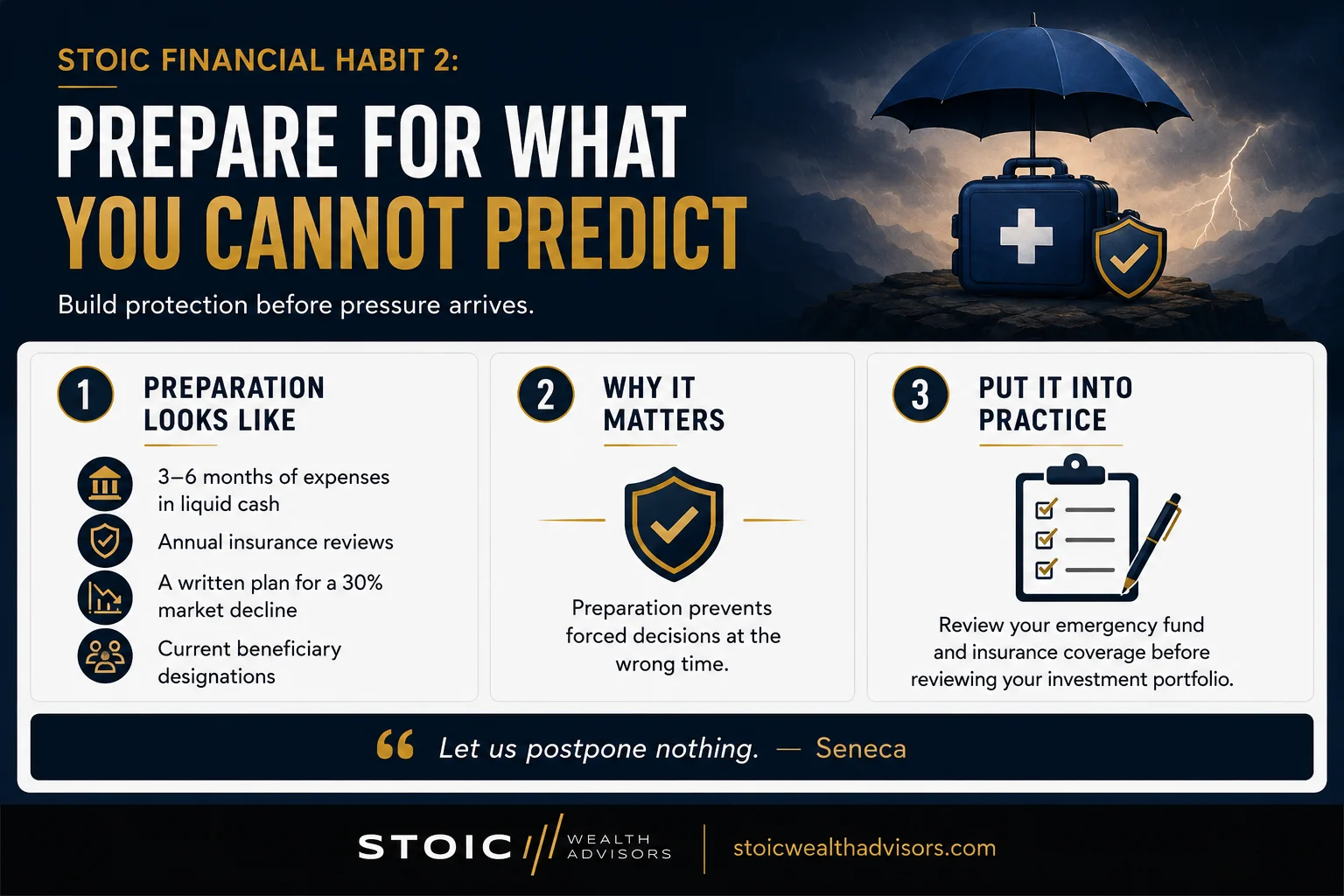
Stoic Financial Habit 2: Prepare for What You Cannot Predict
The Stoic practice of premeditatio malorum, imagining things that could go wrong before they do, is not pessimism. It is the stoic philosophy personal finance principle with the most direct financial application: build structures that hold before the pressure arrives, rather than improvising after it does.
“Let us prepare our minds as if we had come to the very end of life. Let us postpone nothing.” – Seneca, Letters to Lucilius.
Healthcare professionals understand this intuitively in clinical settings. A good protocol handles the unexpected case, not just the routine one. A code cart is stocked before it is needed. A financial plan works the same way.
A client in Prescott learned this the hard way. She had a solid investment account and a solid income. What she did not have was an emergency fund outside of her portfolio. When she had an unexpected medical expense that her insurance did not cover, she had to sell part of her account at a price she would not have chosen. The loss was not large. But it was real, and it was preventable.
Preparation looks like:
- An emergency fund covering three to six months of actual expenses, held in liquid accounts completely separate from investment portfolios
- Insurance coverage is reviewed annually, not just at enrollment, to confirm it still reflects current income, dependents, debts, and liabilities.
- A written financial plan that includes what you will do if markets fall 30%, not just what you hope your behavior will be
- Beneficiary designations are confirmed as current on every account and policy.
A client who has decided in advance that she will not sell equities during a correction unless her plan has fundamentally changed is in a different position than one making that decision in real time, watching a declining number every morning before work.
Put it into practice: Review your emergency fund balance and your insurance coverage before reviewing your investment portfolio. The sequence matters. Preparation before performance.
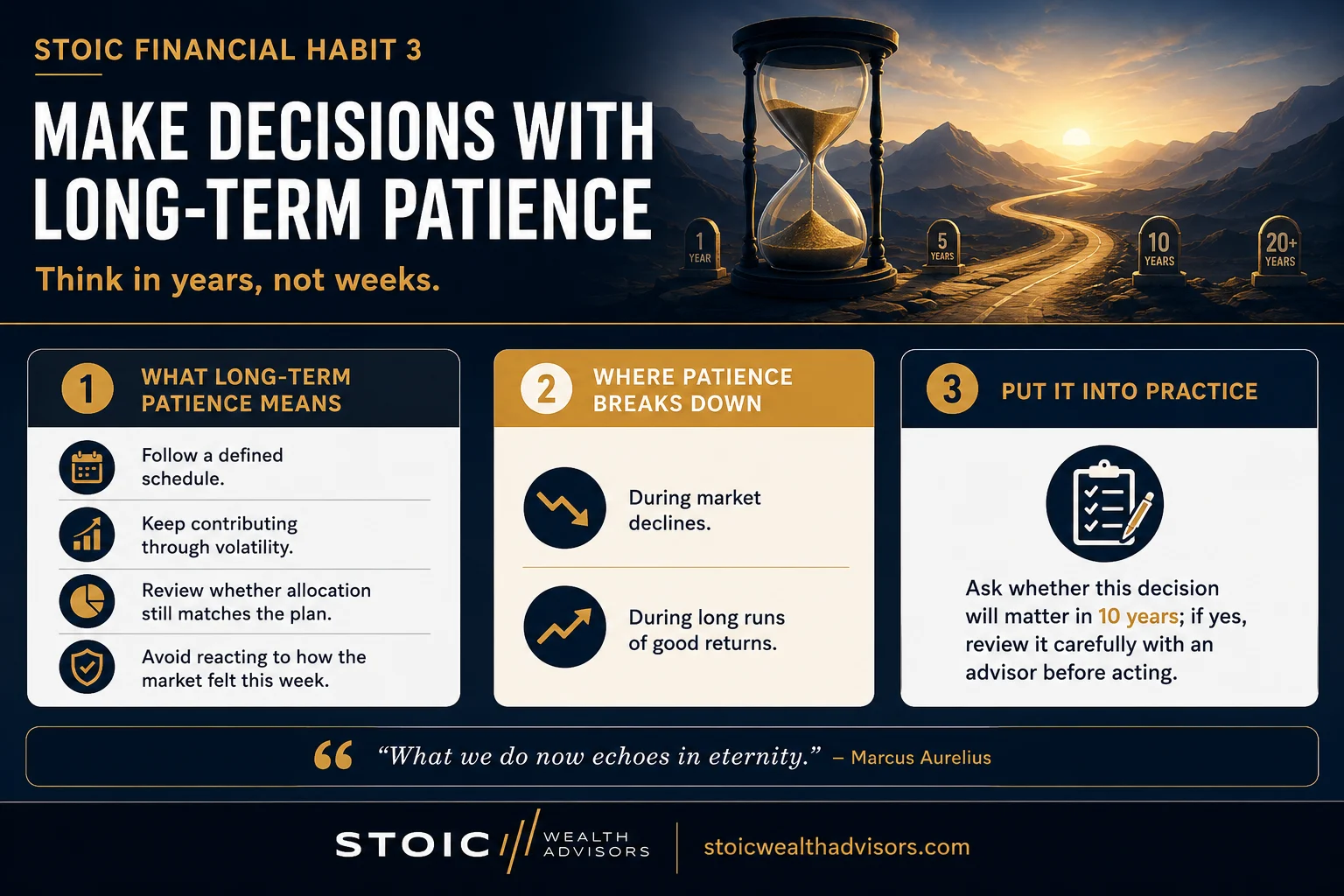
Stoic Financial Habit 3: Make Decisions With Long-Term Patience
Long-term investing discipline is the stoic financial habit most directly tested by market volatility. It means making deliberate decisions on a defined schedule rather than in response to how the market made you feel this week. The Stoics consistently examined choices against a longer timeline, asking whether what felt urgent today would matter in a year or a decade.
“What we do now echoes in eternity.” – Marcus Aurelius, Meditations.
Marcus Aurelius wrote that in a military journal, managing a Roman Empire under constant pressure. His version of a long timeline dwarfs most financial planning horizons. But the discipline translates: decisions made in the heat of the moment, without reference to the longer view, tend to serve the moment and hurt the plan.
Whether the market is up or down this month almost never matters for an investor with a fifteen-year retirement horizon. What matters is whether they kept contributing through the volatility and whether their allocation still reflects what the plan actually calls for.
Long-term patience breaks down in two specific situations. The first is during market declines, when the pressure to act is highest precisely at the moment when acting is most likely to hurt. The second is during extended periods of good returns, when the plan starts to feel unnecessary because everything seems to be working.
Both of these situations are explained in more depth in The Behavior Gap: 4 Emotions That Drive Poor Investment Decisions, which covers the four emotional patterns that override long-term thinking at the exact wrong moment.
Put it into practice: When evaluating any financial decision, ask whether it will matter in ten years. If the answer is no, give it proportional weight. If the answer is yes, give it your full attention, take the time to review it with an advisor, and then decide.

Stoic Financial Habit 4: Spend in Alignment With What You Actually Value
Values-aligned spending is the money mindset habit most people skip because it requires honesty rather than a new tool or strategy. It is not about restriction. It is about whether the money going out each month reflects what you say matters most to you. Most people who feel financially stuck are not overspending randomly. They are spending in ways that quietly conflict with their actual priorities.
“Life is long if you know how to use it.” – Seneca, On the Shortness of Life.
Seneca was not writing about frugality. He was writing about intention. The question is not whether you are spending, but whether the spending reflects how you actually want to use the time and resources you have.
The financial version of this is not complicated to identify, but is often uncomfortable to look at directly. Look at where the money went over the last three months. Then ask whether that pattern reflects your stated priorities.
A physician who says providing for his family is the thing he cares about most, but who has not updated his life insurance since starting practice, or who has no disability coverage despite the fact that his income is the family’s primary resource, has a gap between stated value and actual financial structure. That is not a character flaw. It is a planning gap, and it has a concrete fix.
Acknowledging what has already been built, financially and otherwise, creates the clarity to see what actually needs attention. It is harder to overspend on things that do not matter when you are clear about what does.
Put it into practice: Pull three months of actual spending. Without judgment, compare it to your stated financial priorities. Where the two do not match, you have found the conversation worth having, either with yourself or with an advisor.
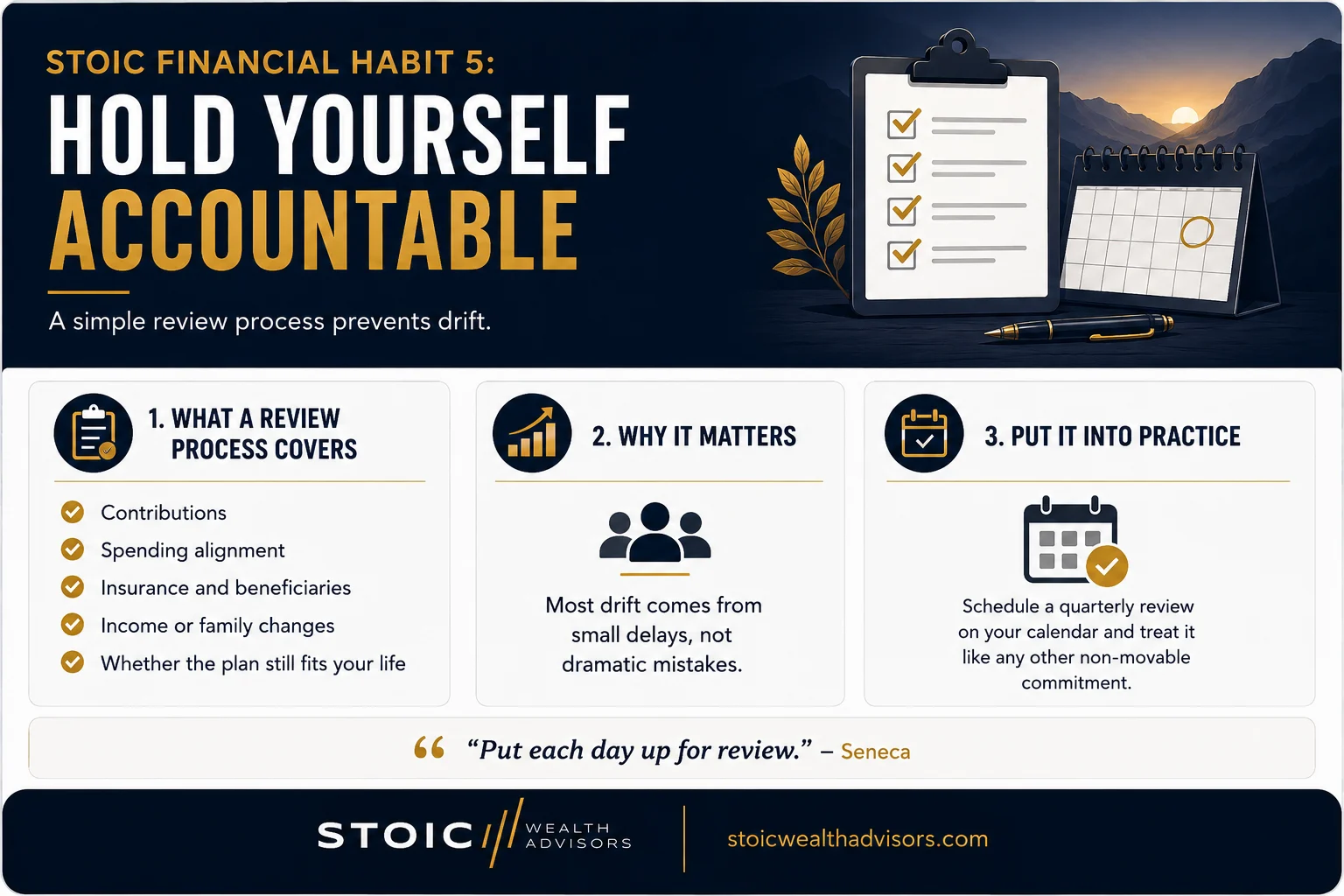
Stoic Financial Habit 5: Hold Yourself Accountable Through a Review Process
The financial discipline habit that most consistently separates people who build wealth steadily from those who do is not investment selection. It is a structured review process. The Stoics treated self-examination as a daily practice, not an annual event. Marcus Aurelius reviewed his own conduct privately and consistently, not because someone required it but because he believed the practice was part of acting well. Financial accountability works on the same premise: without a structured review, drift accumulates slowly enough to be invisible until it is large enough to matter.
“I will keep constant watch over myself and, most usefully, will put each day up for review.” – Seneca, Letters to Lucilius
Most financial drift does not result from a single dramatic wrong decision. It happens through a series of small deferrals. The beneficiary designation was going to be updated after the move. The disability policy was going to be reviewed after the raise. The 403(b) contribution was scheduled to increase after the next promotion. Each individual deferral is understandable. Together, they create a financial plan that no longer reflects the life it was built for.
A review process does not need to be complicated. It needs to happen on a schedule and cover the right things. Quarterly is enough for most people. What changes are whether contributions are happening, whether spending is roughly aligned with the plan, and whether anything has shifted in income, expenses, or the family situation that the plan should reflect.
Self-Assessment: 10 Financial Accountability Questions
Answer each honestly. The questions marked no are the specific conversations worth starting.
| Question | Yes | No |
| Do I know my current net worth within a reasonable range? | [ ] | [ ] |
| Have I reviewed beneficiary designations on all accounts and policies in the last two years? | [ ] | [ ] |
| Am I contributing consistently to a retirement account, and has that amount grown with my income? | [ ] | [ ] |
| Do I have three to six months of actual living expenses in a liquid account outside my investment portfolio? | [ ] | [ ] |
| Have I reviewed my insurance coverage, including disability, life, and liability, within the last three years? | [ ] | [ ] |
| Do I know my approximate marginal tax bracket and how it affects my contribution and withdrawal decisions? | [ ] | [ ] |
| Is my investment allocation appropriate for my actual timeline, or has it drifted without a deliberate review? | [ ] | [ ] |
| Have I had a financial conversation about what happens to my family financially if I cannot work for six months or more? | [ ] | [ ] |
| Do my actual spending patterns reflect the financial priorities I say matter most? | [ ] | [ ] |
| Do I have a review process, even an informal one, for looking at my financial picture at least once a year? | [ ] | [ ] |
Four or more no-answer points to specific, actionable gaps. These are not problems that require shame. They are the normal result of building a demanding professional life without the time or support to build an equally deliberate financial one alongside it.
Put it into practice: Schedule a financial review on your calendar now, the same way you schedule other recurring commitments. Quarterly is enough. Pick a date, enter it, and treat it the same way you treat the professional obligations that do not move.
Why These Stoic Financial Habits Compound Over Time
None of these financial habits produces results in isolation or in a single year. What they do is change the quality of financial decisions made over a decade or more.
An investor who consistently focuses on what they can control stays invested through corrections that shake out reactive investors. An investor who prepares for disruption does not have to sell at the wrong time to cover an unexpected expense. An investor who makes decisions with a long-term timeline does not override a sound plan because of a bad quarter. An investor whose spending reflects their values does not arrive at retirement having funded other people’s priorities for thirty years. An investor who holds themselves accountable through a review process catches drift before it compounds.
The compounding is not just financial. It is behavioral. Each good decision under pressure makes the next one slightly easier. Each review that catches a small drift before it becomes a large one builds a track record of the plan actually working. That track record is what makes it possible to stay the course when the pressure to act is real.
Stoicism did not originate as a financial philosophy. But its core discipline, acting consistently with what you believe, even when external conditions make that difficult, is exactly what long-term financial outcomes require.
At Stoic Wealth Advisors, this philosophy underpins every client relationship. It explains our name, and it shapes the way we work. If you want to see what that looks like in practice, What Sets Us Apart is a good place to start.
Frequently Asked Questions: Stoic Habits and Financial Discipline
1. What are the financial habits?
Financial habits are the recurring behaviors that determine how money is earned, spent, saved, and invested over time. The stoic financial habits that have the most consistent impact on long-term outcomes are: saving a defined percentage of income before spending the rest, contributing to tax-advantaged accounts on a set schedule regardless of market conditions, maintaining a liquid emergency fund, reviewing the financial plan at least quarterly, and making portfolio changes only when the plan has changed, not when the market has.
2. Which Stoic habit matters most for investment behavior?
Focusing on what you can control has the most direct impact on investment behavior. Most investment mistakes come from reacting to things outside anyone’s control: market moves, interest rate decisions, economic data, rather than staying focused on the decisions within reach: contribution rate, asset allocation, emergency fund, and response to volatility. Redirecting energy from the forecast to the plan is where most of the behavioral return comes from.
3. What is premeditatio malorum, and how does it apply to financial planning?
Premeditatio malorum is the Stoic practice of imagining potential setbacks before they occur, not to create anxiety but to make preparation concrete. In financial planning, it means having an emergency fund before a disruption requires one, reviewing insurance coverage before a claim is filed, and deciding in advance how to respond to a market decline rather than improvising under emotional pressure. A financial plan that only accounts for normal conditions is not a plan. It is an assumption.
4. What are financial behaviors?
Financial behaviors are the decisions people make about money, including how they respond to market volatility, how consistently they save, and whether their spending reflects their stated priorities. Behavioral financial research consistently shows that the gap between financial knowledge and financial action is the primary driver of poor long-term outcomes. Understanding compound interest does not prevent someone from selling investments during a correction. Building a structured review process and clear decision rules in advance is what keeps financial behaviors aligned with financial goals.
5. What are poor financial habits?
Poor financial habits are patterns that systematically reduce wealth over time. The most common: spending without reviewing whether it reflects actual priorities; reacting to market movements by selling during declines and reinvesting after recoveries; carrying high-interest debt while deferring retirement contributions; skipping insurance and estate-planning reviews as income grows; and deferring financial decisions until they become urgent. Most poor financial habits are not the result of bad values. They are the result of the absence of a structured plan and a consistent review process.
6. What is the best financial rule?
The most consistently effective financial rule is to control only what you can control and act on it systematically. In practical terms: automate savings contributions so the decision is made once, not monthly; maintain an emergency fund outside investment accounts so market declines never force a sale at the wrong time; review the financial plan quarterly; and make no changes to a portfolio in response to market movement unless the underlying plan has changed. No single investment or timing decision produces more long-term value than the consistent application of these behaviors across a decade or more.
7. What habits make you rich?
The financial habits most consistently associated with long-term wealth building are not complex. Saving consistently over a long period, capturing available employer retirement account matches, allowing compound growth to work without interruption by avoiding reactive selling, reviewing and adjusting the plan as income and circumstances change, and spending in ways that reflect actual priorities rather than lifestyle inflation. Discipline applied to these five areas over twenty or thirty years produces outcomes that most investment selection strategies do not match. Wealth accumulation is primarily a behavioral outcome, not a market-timing outcome.
This content is for general educational purposes and does not constitute individualized financial, investment, tax, or legal advice. Investing involves risk, including possible loss of principal. Consult a qualified financial professional regarding your specific situation. Securities and advisory services offered through LPL Financial, a registered investment advisor, member FINRA/SIPC. Stoic Wealth Advisors and LPL Financial are separate entities.